The Molecular Foundation of Silicone Rubber's Superior Performance
This section aims to articulate the fundamental scientific principles that distinguish silicone rubber from all organic elastomers. The objective is to demonstrate that its superior performance is not incidental but a direct and predictable consequence of its unique, inorganic molecular architecture.
1.1 The Siloxane Backbone (Si-O-Si): A Comparative Molecular Analysis
Silicone rubber is a synthetic elastomer, known as an "organosiloxane polymer," defined by a molecular backbone of repeating silicon-oxygen (Si-O-Si) units. This is a fundamental departure from organic rubbers, which are built upon a carbon-carbon (C-C) main chain.1 This unique structure endows silicone rubber with the dual characteristics of both organic and inorganic materials.3 From a molecular geometry perspective, the Si-O bond has a length of 1.63 Å and a bond angle of 130°, compared to the C-C bond's length of 1.54 Å and angle of 112°.4
This foundational structural difference is the key to understanding silicone's performance. The Si-O-Si backbone is inherently more stable and flexible than its C-C counterpart. The wider bond angles and longer bond lengths afford the polymer segments greater rotational freedom. This explains why silicone rubber maintains its elasticity across an exceptionally broad temperature range, whereas organic rubbers become brittle at low temperatures.3 This superior performance is not a mere enhancement but a result of a fundamental shift in polymer chemistry from an organic (carbon-based) to an inorganic (silicon-based) backbone. Silicone rubber essentially inherits the stability of an inorganic mineral like quartz (silicon dioxide) while retaining the flexibility of an organic polymer, creating a significant performance gap with purely organic materials.
1.2 Bond Energy and Its Direct Impact on Thermal and Chemical Stability
The bond energy of the siloxane (Si-O) bond (433 kJ/mol) is significantly higher than that of the carbon-carbon (C-C) bond (355 kJ/mol) . This higher bond energy is the direct cause of silicone rubber's exceptional thermal stability and chemical inertness. More energy is required to break the Si-O bond, meaning the polymer backbone remains intact at high temperatures that would cause the C-C backbone of organic rubbers to degrade.3
Consequently, a silicone hose can operate continuously at temperatures up to 200°C, whereas standard organic rubbers begin to fail around 120°C to 130°C.3 This vast difference in heat resistance is an intrinsic distinction at the basic chemical level between the two material classes and cannot be bridged by simple modification of organic polymers.
1.3 Inherent Properties Derived from Molecular Structure: Weatherability, Electrical Insulation, and Flexibility
The stable Si-O backbone makes silicone rubber highly resistant to environmental factors such as ozone, UV radiation, and atmospheric aging, whereas the double bonds present in many organic rubbers make them highly susceptible to degradation from these elements.8 Ozone, a powerful oxidant generated by electrical discharge (e.g., within an engine bay), rapidly deteriorates organic rubbers but has almost no effect on the stable siloxane chain.3
Furthermore, the helical structure and low intermolecular forces of polysiloxane molecules contribute to high elasticity, high compressibility, and excellent cold resistance, with an embrittlement point as low as -60°C to -70°C.3 The Si-O bond also imparts excellent electrical insulation properties to the material.8 However, this flexible molecular architecture also presents an inherent design limitation. The loose, helical structure of polysiloxane chains, while providing excellent low-temperature performance, results in larger intermolecular voids compared to more tightly packed elastomers like nitrile. These larger gaps allow gas molecules to permeate more easily, leading to silicone's relatively high gas permeability.4 This means that, unless specially formulated or constructed, standard silicone hoses are not suitable for applications requiring a high degree of gas-tightness.
The Anatomy of a Silicone Hose: A Composite Engineering Perspective
This section deconstructs the silicone hose as an engineered system, illustrating how disparate materials are layered in a composite structure to create a final product whose performance far exceeds that of its individual components.
2.1 Multi-Layer Composite Structure: The Synergy of Materials
A silicone hose is a composite product, typically consisting of an inner rubber layer (tube), a reinforcement layer, and an outer rubber layer (cover).10 The inner and outer layers are generally made of silicone rubber, while the reinforcement consists of one or more plies of fabric or wire.10 This construction gives the hose a "fail-safe" characteristic, as any leak must follow a tortuous path through the multiple layers, preventing catastrophic, sudden bursts.12 This demonstrates that a "silicone hose" is far more than just silicone; it is a composite system where the silicone provides thermal and chemical resistance, and the reinforcement provides mechanical strength, such as pressure resistance and structural integrity.
2.2 Reinforcement Material Analysis: Customizing Performance for the Application
The performance of a silicone hose can be precisely tuned for its specific operating environment by selecting different reinforcement materials:
Polyester: The standard reinforcement for general-purpose applications, suitable for temperatures from -54°C to 177°C. It is the most common and cost-effective choice, ideal for standard automotive coolant and heater hoses.8
Aramid (e.g., Nomex®) and Fiberglass: Used for high-temperature applications, these materials extend the upper operating limit to 260°C.8 They are specified for severe environments such as turbocharger connections (charge air cooler hoses) and exhaust gas recirculation (EGR) systems, where temperatures far exceed the limits of polyester.15
Wire Reinforcement: A steel wire helix wound between fabric plies is used to increase the hose's pressure rating, provide kink resistance, and, most critically, prevent collapse under vacuum (negative pressure) conditions.14 This is essential for suction lines or applications where pressure drops may occur.
The evolution from fiberglass to aramid (Nomex®) as a high-temperature reinforcement was driven by a sophisticated understanding of secondary failure modes, not just heat resistance. While both can withstand temperatures up to 260°C, fiberglass, being a glass-based material, is inherently brittle and prone to fatigue failure under the high-frequency vibrations common in engine compartments.11 Aramid fiber, being a polymer, offers superior flexibility and fatigue resistance, allowing it to endure constant vibration without fracturing. The selection of aramid over fiberglass is therefore a precision engineering decision that accounts for both thermal and vibrational stresses.
Furthermore, the "ply count" (number of reinforcement layers) directly dictates the hose's pressure rating and stiffness. Each additional ply of fabric increases the wall thickness, thereby increasing its ability to withstand internal pressure (burst pressure).15 However, increasing the ply count also makes the hose stiffer, which increases its minimum bend radius.19 This means an engineer cannot simply specify the highest ply count but must trade off pressure performance against the physical constraints of the installation space.
Table 2.1: Performance Comparison of Silicone Hose Reinforcement Materials
| Reinforcement Material | Typical Continuous Operating Temperature Range | Key Advantages | Common Applications | Relative Cost |
| Polyester | -54°C to 177°C | Cost-effective, good flexibility | Standard automotive coolant/heater hoses | Low |
| Aramid (Nomex®) | -54°C to 260°C | Excellent high-temperature resistance, vibration fatigue resistance | Turbochargers, charge air coolers, EGR systems | High |
| Fiberglass | -54°C to 260°C | Excellent high-temperature resistance | High-temperature air and fume handling | Medium |
| Stainless Steel Wire | -54°C to 260°C | Resists vacuum collapse, anti-kink, high pressure | Vacuum/suction lines, high-pressure applications | High |
Manufacturing and Vulcanization: The Chemical Processes that Define the Final Product
This section will illuminate the critical manufacturing step of vulcanization, arguing that the choice of curing chemistry is as important as the base polymer in dictating the final product's performance, purity, and suitability for sensitive applications.
3.1 The Vulcanization Process: From Plastic Gel to High-Performance Elastomer
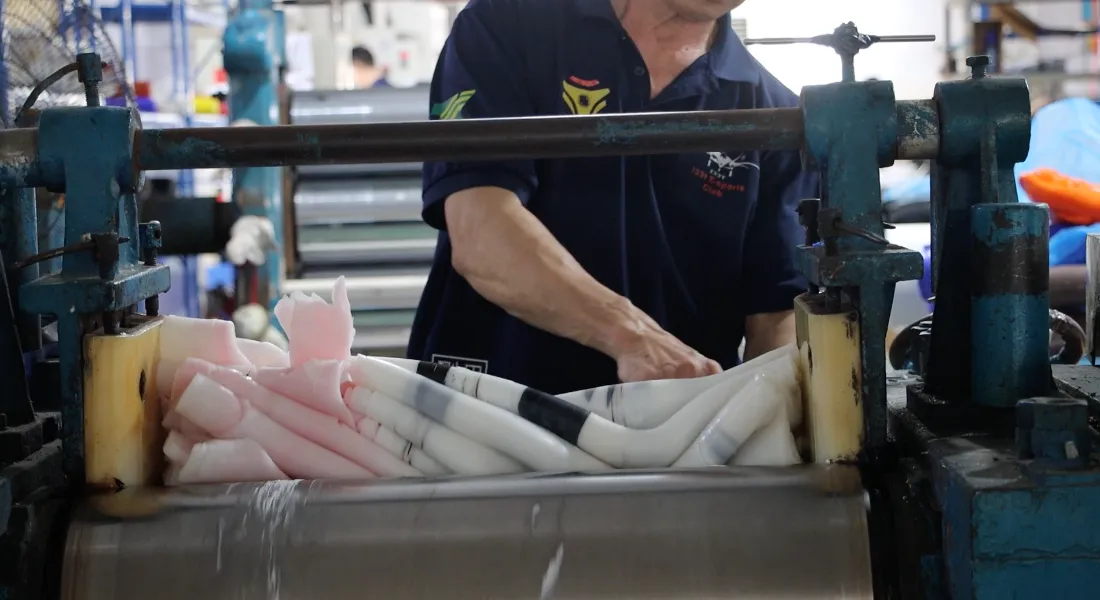
In its uncured state, silicone is a gel or liquid.4 Vulcanization is a chemical process that transforms the material from this plastic state into a stable, durable, solid elastomeric form by cross-linking the polymer chains.20 This process gives silicone rubber its "shape memory" and resilience. Without cross-linking, the polymer chains would slide past one another under stress, resulting in permanent deformation. The process is typically performed in two stages: an initial molding and curing step, followed by a prolonged post-curing process to stabilize properties and remove by-products.4
3.2 Key Comparison: Platinum-Curing vs. Peroxide-Curing
There are two primary vulcanization systems for silicone rubber, which differ significantly in their chemical mechanism, final product purity, and performance:
The choice of curing method effectively stratifies the market into two distinct tiers: "industrial grade" (typically peroxide-cured) and "high-purity grade" (platinum-cured). For an application like an automotive coolant line, trace acidic by-products are inconsequential, making the less expensive peroxide-cured product suitable. For a pharmaceutical fluid transfer line, however, any leachable by-product could contaminate a high-value drug product, mandating the use of a platinum-cured product. The post-curing step is particularly critical for peroxide-cured silicones; its purpose is to drive off volatile by-products and complete any residual cross-linking through a prolonged bake, thereby improving the material's stability.
Table 3.1: Technical Comparison of Platinum-Cured vs. Peroxide-Cured Silicone
| Property | Platinum-Cured Silicone | Peroxide-Cured Silicone |
| Curing Mechanism | Addition Cure | Free-Radical Cure |
| By-products | None | Potential for acidic residues |
| Purity / Biocompatibility | Very High | Lower; not for high-purity applications |
| Typical Applications | Medical, Pharmaceutical, Food & Beverage | Automotive, General Industrial |
| Tensile / Tear Strength | Excellent | Good |
| Clarity | High, non-yellowing | Lower, can yellow over time |
| Cost | Higher | Cost-effective |
| Catalyst Sensitivity | Sensitive to certain chemicals | Robust |
In-Depth Analysis of Performance Characteristics
This section quantifies the performance of silicone hoses, providing concrete data on their thermal, mechanical, and chemical properties, while also delving into their primary limitations and the engineering solutions developed to overcome them.
4.1 Thermal Performance: A Class-Defining Characteristic
The most prominent advantage of silicone hoses is their exceptionally wide operating temperature range. Standard silicone hoses function from approximately -54°C to 177°C.28 By using high-temperature reinforcements like aramid or fiberglass, the continuous operating temperature can be extended to 260°C, with some products capable of withstanding short-term excursions to 350°C.3 The brittle point is extremely low, around -60°C to -70°C, far superior to the -20°C to -30°C of typical organic rubbers.3 This massive operational window makes it the default choice for applications involving thermal extremes, such as automotive cooling systems.
4.2 Mechanical Properties: Durability and Resilience
Silicone rubber exhibits excellent resistance to compression set at extreme temperatures, meaning it recovers its original shape after prolonged compression, which is critical for sealing applications.30 It has high flexibility, resilience, and elongation (>600% at break).4 However, compared to some organic rubbers, silicone has a relatively low tensile strength (approx. 5-10 MPa) and poor abrasion and tear resistance.4 This is a key weakness, and silicone hoses should not be used in applications where they will rub against abrasive surfaces without a protective sleeve.30
4.3 Chemical Compatibility and Its Critical Limitations
Resistance: Silicone rubber is generally chemically inert and exhibits excellent resistance to water, steam (to a limit), coolants (ethylene/propylene glycol), dilute acids and bases, and polar organic compounds.3
Limitation: Hydrocarbon Fuels and Oils: Standard silicone is not resistant to non-polar organic compounds such as gasoline, diesel fuel, and petroleum-based oils.3 These substances cause the silicone to swell, soften, degrade, and ultimately lose all mechanical properties.3
This incompatibility stems from the "like dissolves like" principle of chemistry. The polysiloxane polymer is non-polar due to the methyl groups surrounding its backbone. Hydrocarbon fuels and oils are also non-polar. When they come into contact, the non-polar solvent molecules can easily permeate and interact with the non-polar polymer chains, causing swelling and degradation. Conversely, coolants like water and ethylene glycol are highly polar molecules. They have little chemical affinity for the non-polar silicone polymer and are thus repelled, resulting in excellent resistance and very low water absorption.9 This reveals a fundamental chemical trade-off: the very properties that make silicone resistant to coolant make it susceptible to fuel.
Engineered Solution: Fluorosilicone and Fluorocarbon Liners: To overcome this limitation, high-performance hoses employ a composite construction featuring an inner liner made of fluorosilicone (FVMQ) or fluorocarbon (FKM/Viton®) rubber.39 These fluoroelastomers create an impermeable barrier that is highly resistant to fuels, oils, and aggressive chemicals, thereby protecting the structural silicone outer layers.37 The development of this composite hose was a major materials engineering advance, combining the thermal resistance of silicone with the chemical resistance of a fluoropolymer to achieve a level of performance unattainable by any single material.
Specific Application Analysis and Regulatory Compliance
This section integrates the material properties discussed previously with the demanding requirements of key industries, demonstrating how compliance with stringent regulatory standards positions silicone hoses as an enabling technology in these sectors.
5.1 Automotive Industry: High Performance and the Electric Vehicle Revolution
High-Performance Internal Combustion Engines (ICE): In high-performance applications such as turbocharger and charge air cooler (CAC) connections, cooling/heating systems, and vacuum lines, silicone hoses are the standard. This is because they can withstand the high temperatures (up to 260°C) and pressures generated by forced induction systems.10 Compared to EPDM hoses, which degrade at high temperatures, silicone offers a much longer service life.16
Electric Vehicle (EV) Battery Thermal Management: Silicone hoses play a critical role in the thermal management systems of EV battery packs, motors, and power electronics, where they are used to circulate liquid coolant.43 Key properties include:
Temperature Resistance: To manage heat generated during fast charging and high-power discharge.43
Flexibility: To allow for routing in complex and compact vehicle architectures.43
Electrical Insulation: To prevent short circuits in the high-voltage battery pack environment.8
Chemical Compatibility: Excellent resistance to long-life automotive coolants (OAT, HOAT, glycol-based).34
5.2 Medical and Pharmaceutical Industries: The Purity Imperative
Biocompatibility and Inertness: Medical-grade, platinum-cured silicone is used for fluid transfer tubing, catheters, and drains because it is highly biocompatible, non-toxic, hypoallergenic, and does not react with bodily fluids or support bacterial growth.4
Sterilization Resistance: Silicone tubing can be repeatedly sterilized via autoclave, ethylene oxide (EtO), or gamma radiation without significant degradation of its properties.30
Regulatory Standard: USP Class VI: This is the most stringent standard for the biocompatibility of plastics used in medical devices. It requires a series of in-vivo biological reactivity tests (systemic injection, intracutaneous reactivity, and implantation) to ensure the material does not cause adverse effects when in contact with living tissue.48 USP Class VI certification is typically a baseline requirement for medical-grade silicone.25
5.3 Food and Beverage Processing: Hygiene and Cleanability
Material Purity: Food-grade, platinum-cured silicone is used because it is odorless, tasteless, chemically inert, and non-toxic, ensuring it does not transfer any undesirable substances to the food products it contacts.30
Cleanability: These hoses have an ultra-smooth inner bore to prevent bacterial adhesion and are designed to withstand rigorous cleaning and sanitizing procedures, including Clean-In-Place (CIP) and Steam-In-Place (SIP).19
Regulatory Standard: FDA 21 CFR 177.2600: This regulation specifies the elastomers, additives, and fillers that are permissible for use in rubber articles intended for repeated food contact. It also sets strict limits on the amount of extractable substances that can migrate from the material into food simulants.54
Regulatory Standard: 3-A Sanitary Standards: Building on FDA compliance, this standard (specifically 18-03 for rubber-like materials) focuses on the durability of the material and its ability to be effectively cleaned and sanitized. It involves accelerated use-simulation testing with specific cleaning agents (e.g., phosphoric/nitric acid, sodium hydroxide, chlorine) to ensure the material can maintain its surface finish and functional properties throughout its service life.57
These regulatory standards form a clear hierarchy that reflects increasing application risk. FDA 21 CFR 177.2600 is the foundation, ensuring the passive chemical safety of the material. The 3-A Sanitary Standard goes further, addressing active hygiene and durability in industrial cleaning cycles. USP Class VI sits at the apex, evaluating the direct biological reactivity of the material with living tissue for the highest-risk medical applications. This hierarchy explains why a material may be FDA compliant but not suitable for pharmaceutical use (fails 3-A), or 3-A compliant but not for a medical implant (fails USP Class VI).
Comparative Material Analysis: Selecting the Optimal Elastomer
This section provides a decision-making framework for material selection by comparing silicone hoses against their most common organic rubber alternatives, based on a trade-off analysis of performance, cost, and application environment.
6.1 Silicone vs. EPDM: The Trade-off Between Ultimate Performance and Cost-Effectiveness
Temperature Range: Silicone's temperature range (-54°C to 260°C) is far superior to that of EPDM (-40°C to 127-150°C).16 At temperatures that cause severe deformation in EPDM, silicone shows almost no shrinkage or degradation.61
Longevity and Durability: Both have excellent weather and ozone resistance. However, in high-heat applications, silicone's resistance to thermal degradation gives it a much longer service life. EPDM may offer better physical abrasion resistance.42
Cost: EPDM has a significantly lower upfront procurement cost than silicone.38
Total Cost of Ownership (TCO): For demanding applications like commercial trucks, the longer service life of silicone hoses (e.g., "million-mile hoses") reduces downtime and lifetime maintenance costs, justifying the higher initial investment.38 This concept shifts the selection from a simple cost comparison to a strategic operational decision, as the cost of a single roadside failure (towing, downtime, repairs, fines) can far exceed the price difference of the hose itself.
Conclusion: EPDM is the cost-effective choice for standard automotive and industrial cooling systems. For high-performance, high-heat, or long-life and high-reliability applications, silicone is the necessary choice.
6.2 Silicone vs. Nitrile Rubber (Buna-N): A Classic Performance Trade-off
Oil/Fuel Resistance: Nitrile (NBR) is the industry standard for fuel and oil applications due to its excellent resistance to petroleum-based products. Standard silicone has poor oil and fuel resistance.35
Temperature Range: Silicone's temperature range (approx. -101°C to 249°C) is far superior to that of nitrile (approx. -40°C to 121°C).31
Weather Resistance: Silicone has excellent resistance to UV and ozone, whereas nitrile performs poorly in this regard and is not suitable for outdoor exposure.31
Mechanical Properties: Nitrile has better tensile strength, abrasion resistance, and tear resistance.31
Conclusion: This is a clear choice based on the fluid being conveyed. For fuel, oil, and hydraulic fluids at moderate temperatures, nitrile is the correct choice. For coolants, air, or water at extreme temperatures, silicone is the correct choice. For applications requiring both high-temperature and oil resistance, the only solution is a fluorosilicone-lined silicone hose.
Table 6.1: Performance Comparison of High-Performance Elastomer Hoses
| Performance | Silicone | EPDM | Nitrile Rubber (Buna-N) | Fluorosilicone-Lined Silicone |
| Continuous Operating Temp. Range | Excellent (-54°C to 260°C) | Good (-40°C to 130°C) | Fair (-40°C to 121°C) | Excellent (-55°C to 230°C) |
| Oil/Fuel Resistance | Poor | Poor | Excellent | Excellent |
| Weather/UV/Ozone Resistance | Excellent | Excellent | Poor | Excellent |
| Abrasion Resistance | Poor | Good | Excellent | Poor |
| Relative Cost | Medium-High | Low | Low | Very High |
| Optimal Use Case | High-temp coolant, air, turbocharging | Standard automotive cooling systems | Fuel, oil, hydraulic systems | High-temp fuel/oil, EGR systems |
Synthesis and Future Outlook
7.1 Summary of Silicone Hose as a High-Performance Engineering Material
The comprehensive analysis confirms that the superior performance of silicone hoses is rooted in their unique Si-O-Si molecular backbone, which provides inherent advantages in thermal, chemical, and environmental stability. When engineered as a composite with specific reinforcements and liners, it transforms into a versatile, high-performance solution capable of serving in extreme application environments where conventional organic rubbers fail. In essence, the value of a silicone hose lies in its ability to deliver unparalleled reliability and extended service life under severe conditions.
7.2 Emerging Trends and Future Developments
The market for silicone hoses continues to expand, driven by key technological advancements. In the electric vehicle sector, its importance is growing not only for battery cooling but for all fluid transfer systems that demand long life and high reliability.43 Ongoing innovations in materials science are also pushing its performance boundaries, such as the use of new meta-aramid reinforcements for better adhesion at extreme temperatures.11 Furthermore, the development of advanced manufacturing processes like Liquid Silicone Rubber (LSR) injection molding is enabling the creation of more complex, integrated hose components, which can reduce assembly costs and improve system design precision.62 In the future, silicone hoses will continue to be a critical material, enabling ongoing technological innovation across the automotive, medical, aerospace, and industrial sectors.